Dark Patterns, Consent Failures, and the Gap Between Policy and Practice

The most common question privacy teams ask after a Privaini assessment is some version of this: "How did we miss that?"
The answer is almost never negligence. It is almost always architecture.
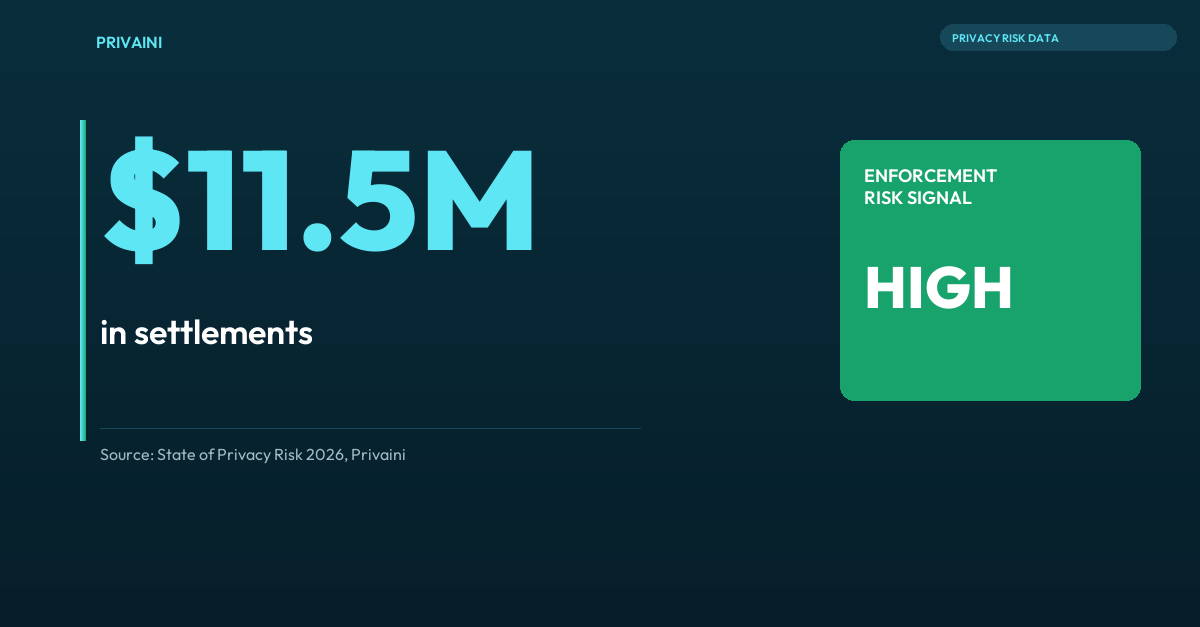
The violations that generate regulatory enforcement actions and class action filings are rarely the obvious ones. They are not unlocked trackers left in place after a consent banner audit, or a missing privacy policy on a forgotten microsite. The violations that drive real exposure -- VPPA class actions averaging $11.5M in settlements, CPPA enforcement approaching seven figures, wiretapping class actions accumulating across California and Pennsylvania -- tend to originate from something more subtle and more dangerous.
They originate from the policy-practice gap.
What the Policy-Practice Gap Actually Means
The policy-practice gap is the delta between what a company's privacy policy discloses and what is actually observable in its digital behavior.
Here is a concrete example. A company deploys a video analytics platform on its website -- a common tool used by thousands of organizations to understand how users engage with product demos, educational content, or customer success videos. The tool works as intended. The marketing team uses it. The analytics team builds dashboards from it.
But the privacy policy was last updated 18 months ago, before the video analytics tool was deployed. The policy describes data sharing with advertising and analytics partners in general terms that do not adequately capture what this specific tool is doing -- collecting viewing behavior and sharing it with the platform vendor and its downstream advertising ecosystem.
The result: VPPA exposure. Not because the tool was unauthorized. Not because the data collection was hidden from internal teams. But because the practice -- authorized, deliberate, operational -- was not adequately disclosed in the privacy policy observable to users and, critically, to regulators and plaintiff attorneys.
This is the pattern behind the majority of significant privacy enforcement actions. And it is structurally invisible to every inside-out privacy tool on the market.
Why Inside-Out Tools Cannot See This
Inside-out privacy tools -- consent management platforms, privacy program management software, internal data discovery tools -- are designed around a specific assumption: that privacy risk is a documentation and workflow problem. If you maintain accurate data flow records, configure your consent banners correctly, and keep your privacy policy updated, you have addressed your risk.
This assumption fails at the point of execution. Technology stacks change faster than documentation update cycles. Marketing and engineering teams deploy new tools -- analytics platforms, AI chatbots, session recording tools, advertising pixels -- without triggering legal or privacy review. Third-party tools introduce data flows that are not visible from inside the organization without purpose-built detection.
An inside-out tool reads what the company has already documented internally. It cannot observe what is happening at the user experience layer -- what a regulator sees when they load the website, what a plaintiff attorney discovers when they audit observable data practices.
The policy-practice gap is only detectable from the outside.
The Consent Failure Spectrum
Not all consent failures are equal. Understanding the spectrum helps prioritize which gaps carry the most exposure.
Disclosure gaps are the most common and most dangerous. The practice exists. The disclosure does not adequately describe it. VPPA, wrongful collection, and GDPR inadequate disclosure violations originate here.
Consent mechanism failures are observable and heavily enforced. The consent banner fires correctly, but the pre-ticked boxes, the buried opt-out paths, and the asymmetric accept/reject flows are visible to anyone who loads the page. The CPPA's early enforcement actions focused specifically on consent UX -- not on whether consent banners existed, but on whether they actually gave users a meaningful choice.
Dark patterns sit at the intersection of consent failure and affirmative deception. The patterns regulators and litigants focus on: making acceptance easier than rejection, using confusing language to obscure what the user is agreeing to, requiring multiple steps to opt out while acceptance is a single click, and burying privacy controls in unintuitive locations. These are observable behaviors -- not internal documentation failures.
Jurisdictional gaps occur when a company's consent and disclosure practices meet the requirements of one jurisdiction but not another. An organization may have compliant GDPR consent mechanisms for European users while its practices create CPRA violations for California users and BIPA exposure for Illinois residents. Jurisdictional compliance is not a binary -- it is a mapping exercise that requires knowing where users are located and what regulations apply to each.
The ICO Validation
In 2025, Privaini's findings were used in a live UK ICO regulatory response. The significance of that use case is not promotional -- it is evidentiary.
When a Data Protection Authority initiates an investigation, they observe from the outside. They do not request internal documentation first. They load the website, test the consent flows, examine the cookie behavior, audit the privacy policy against observable data practices. They build their case from what is publicly accessible.
The value of Privaini's methodology in that response was precisely that its findings were reproducible, timestamped, and jurisdiction-specific -- the same standard the regulator applies. Not AI-generated inference. Not plausible summaries. Verifiable observations with a documented chain of evidence.
The policy-practice gap, when identified by outside-in assessment, is not a hypothesis. It is documented evidence of the same kind regulators produce when building enforcement cases. The organizations that find it first have the opportunity to close it. The organizations that do not find it first learn about it from the other side.
What to Do About It
The policy-practice gap is addressable. The challenge is visibility -- internal teams cannot see what outside-in assessors see without purpose-built external assessment.
The starting point is an outside-in audit of your own digital footprint: what is actually observable about your consent flows, your tracker behavior, your data sharing practices, and the accuracy of your privacy policy disclosures relative to what is running on your properties. The audit should be jurisdictionally mapped -- the requirements that apply to your California users differ from those applicable to your German users and your Illinois employees.
The second step is establishing a process for keeping that picture current. Technology stacks change. New tools get deployed. Third-party platforms update their data collection behaviors. The policy-practice gap is not a one-time finding; it is a recurring exposure that grows as technology evolves faster than documentation.
The third step is verification -- not just remediating what you find, but confirming that remediations are actually working as observable from the outside. A corrected consent banner that is still not functioning correctly in a specific browser, or on mobile, or for users in a specific geography, has not actually remediated the exposure.
The organizations facing the most significant privacy enforcement actions and class action filings in 2025-2026 are not the ones that ignored privacy. They are the ones whose programs were looking in the wrong direction.
The policy-practice gap is observable. The question is who observes it first.